

Photo: Justin Doub · CC BY 2.0 · cropped · View on Wikimedia Commons
The move — THE KNIFE
Masaharu Morimoto
Draw the blade through in one stroke. Sawing tears the fibres and the flesh turns cloudy.
Morimoto trained in sushi and kaiseki before he was famous for anything, and the thing I took from him comes from that training rather than from television. A cut is one stroke. You place the heel of the blade, draw it through and lift. You do not saw, you do not press, and you do not go back over it.
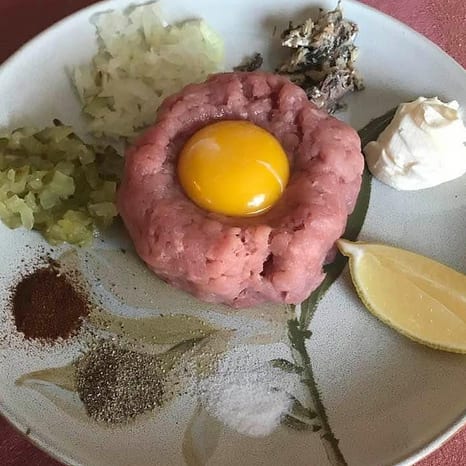
The reason is visible on the plate within a minute. Sawing tears muscle fibre rather than severing it, and torn fibre leaks. Raw fish cut badly goes cloudy at the edges and loses the wet gloss that makes it look alive. The same thing happens to beef for a tartare, which is why hand-chopping with a sharp knife beats a grinder every time.
It taught me that knife work is not about speed. It is about not damaging the thing you are cutting. Almost every kitchen skill I care about since has turned out to be a version of that.
Three dishes Masaharu Morimoto is known for
Tuna pizza
Morimoto restaurants, Philadelphia onward
The dish that travels to every Morimoto he opens, and the one most people order on a first visit. It is a clean statement of what he does — Japanese material, Western form, and no apology for either.
What makes it work
A thin crisp base, cold raw tuna laid on after it comes off the heat, and an assembly built so the fish is never warmed. It is the same hot-base-cold-topping logic as Puck's salmon pizza, arrived at from an entirely different direction, and it depends completely on how the tuna is sliced.
Toro tartare
Morimoto, Philadelphia and New York
One of the signature plates of his restaurants and a dish that turned a tartare into theatre — served with the garnishes arranged separately for the diner to work through rather than pre-mixed.
What makes it work
Fatty tuna belly worked with the blade rather than mashed, kept extremely cold throughout, and assembled at the last moment. The diner combines it themselves, which means every element has to stand up alone rather than hide in a mixture. That is a harder thing to plate than it looks.
Bell pepper sushi
Iron Chef Japan, 1999 sushi battle
The dish that announced he would not be doing what was expected. Putting bell pepper into sushi on Japanese national television, in a sushi battle, against a traditional sushi chef, was close to provocation — and it is still the Morimoto dish people who watched the original series remember.
What makes it work
The interesting part is not the novelty. It is that the traditional discipline underneath was intact — the rice, the cut, the proportion were all correct, which is the only reason the substitution read as an idea rather than a mistake. You can break a rule convincingly only if everything around it is exact.
What I cook because of Masaharu Morimoto
One chopped entirely by hand, and one where the whole dish depends on how evenly you can cut a sheet of dough.

A note
Everything above is my own writing about a cook whose work changed how I cook. None of it is their recipe -- I never reproduce a recipe here, only my own account of a technique I took from watching them. The photograph is a Creative Commons image, used editorially and cropped; see the credit above. Its appearance here does not imply any endorsement, affiliation or connection between this site and the person pictured.