

Photo: © Glenn Francis, PacificProDigital.com · CC BY-SA 3.0 · cropped · View on Wikimedia Commons
The move — HOT AND COLD
Wolfgang Puck
Something hot and something cold on the same plate, and never cook the delicate half.
Puck's smoked salmon pizza is the clearest lesson in temperature contrast I know, and it happened by accident. Joan Collins ordered smoked salmon at Spago, the kitchen had run out of brioche, and he put it on hot pizza dough instead. Crème fraîche, caramelised shallots, caviar, and cold cured salmon laid on a base straight out of the oven.
What matters is what he did not do. The salmon never goes near the heat. It is laid on after the base comes out, so it stays cold, soft and cured rather than turning into cooked fish. The hot element does the work of cooking; the cold element supplies everything heat would destroy.
Once you notice it you see it everywhere worth eating — warm potatoes under cold soured cream, hot pasta finished with raw tomato, seared beef under cold horseradish. The rule is simple: decide which half of the plate is delicate, and then keep the fire away from it.
Three dishes Wolfgang Puck is known for
Smoked salmon pizza
Spago, Los Angeles, early 1980s — created for Joan Collins
It is the dish that defined Spago and, by extension, California cuisine — the moment pizza stopped being cheap food and started being something a Hollywood restaurant could build a reputation on. It has been on his menus for four decades.
What makes it work
The base is baked alone and hot. Dill crème fraîche, caramelised shallots, cold house-cured salmon and caviar all go on afterwards. The salmon is cured in-house over several days with cloves, bay, parsley, thyme and brown sugar. Nothing delicate touches the oven.
Chinois chicken salad
Chinois on Main, Santa Monica
One of the dishes that made the case for deliberate Asian and French technique on one plate in an American restaurant, at a point when that combination was widely treated as a gimmick rather than cooking.
What makes it work
The same contrast logic in a different register — crisp raw and lightly dressed elements against something warm and rich, with acid doing the work of cutting through. Texture is doing as much as flavour, and the dressing goes on at the last possible moment so nothing wilts.
Wiener schnitzel
Austrian by birth, and on his menus throughout his career
The dish he keeps coming back to, and the one that anchors a career otherwise spent in California to where he actually came from. It shows up in his restaurants long after he had no need to cook anything traditional.
What makes it work
Veal beaten genuinely thin, a dry-flour-egg-crumb sequence with nothing pressed down, and enough hot fat that the coating puffs and separates from the meat rather than gluing itself on. The pan is swirled so fat washes over the top. A schnitzel that sits flat in shallow oil is a schnitzel that will be heavy.
What I cook because of Wolfgang Puck
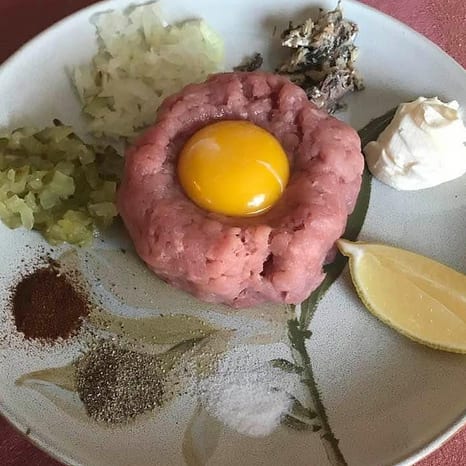
One where the fish is barely cooked, one where nothing is cooked at all and everything cold is assembled at the table.

A note
Everything above is my own writing about a cook whose work changed how I cook. None of it is their recipe -- I never reproduce a recipe here, only my own account of a technique I took from watching them. The photograph is a Creative Commons image, used editorially and cropped; see the credit above. Its appearance here does not imply any endorsement, affiliation or connection between this site and the person pictured.