Dill Anethum graveolens
The fronds are delicate and the seeds are not. Fronds go in at the end; the seeds will stand up to a pickling brine.
2 recipes on this site
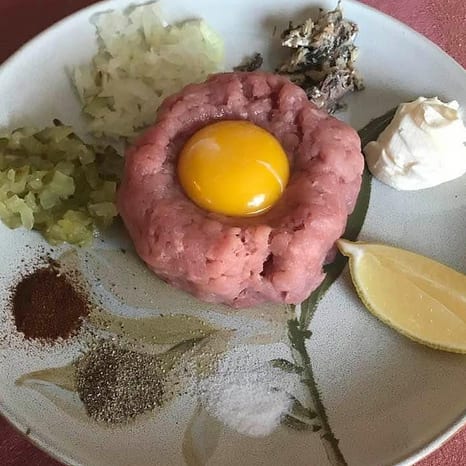
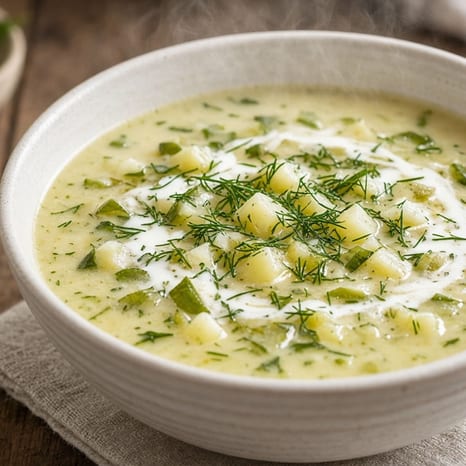
Ingredient reference image: AI-generated. Recipe photography is my own.
In the kitchen
The leaf goes in last
Dill fronds collapse in heat faster than almost any other herb — a minute in a hot pan and the flavour is gone and the colour with it. Off the heat, or stirred through at the table.
The seed goes in early
Bruise it first, then let it cook. In a brine it wants twenty minutes or more to give anything up, and in a rye dough it can go through the bake without losing much.
It hates being chopped fine
Dill has no structure to speak of. Chopped small it turns to green mush and bruises; pick the fronds off the stem with your fingers and scatter them whole.
Beyond the kitchen
PICKLING
The whole flowering head — stalk, umbel and green seed together — is what goes in a jar of dill pickles, not the fronds. Its season is short and its arrival is what sets the cucumber-pickling calendar in central and eastern Europe.
COMPANION PLANTING
Grown near cabbages and onions to draw hoverflies and predatory wasps. It is also a swallowtail host plant. Keep it well away from carrots: they are close enough relatives to cross-pollinate, and the seed you save will be useless.
CUT FLOWERS
The yellow umbels are sold by florists as a filler and last well in a vase. Dill flowers are among the few herbs grown commercially as much for the flower as for the leaf.
THE NAME
The English name comes through Old English dile from a Germanic root, and the Latin species name graveolens means strong-smelling — the same word attached to several plants that announce themselves from a distance.
A longer history
Dill has been in use around the eastern Mediterranean and Near East for at least three thousand years. It is named in the Ebers Papyrus, an Egyptian medical compilation of around 1550 BCE, and has been identified at Egyptian and Near Eastern archaeological sites. It appears in the Talmud in the context of tithing, which tells you it was a cultivated crop of some value rather than a wild plant.
It is one of the very few herbs named in the New Testament, in a passage in Matthew about tithing mint, dill and cumin — a detail that fixes its ordinariness in first-century Judea as much as its importance. Roman writers list it among common kitchen and garden plants.
Its modern centre of gravity is northern and eastern rather than Mediterranean. Poland, Russia, Ukraine, Scandinavia and the Baltic states use it at a volume that would startle an Italian cook, and much of the world's dill-heavy cooking — gravlax, borscht, pickles, new potatoes in butter — comes from that band of countries.